
Whilst the agronomic benefits are clear the challenges remain with post-harvest processing and marketability. Unless fed directly to livestock, growers require investment in capital equipment and sufficient scale to achieve a critical mass for viability – this remains out of reach for the majority.
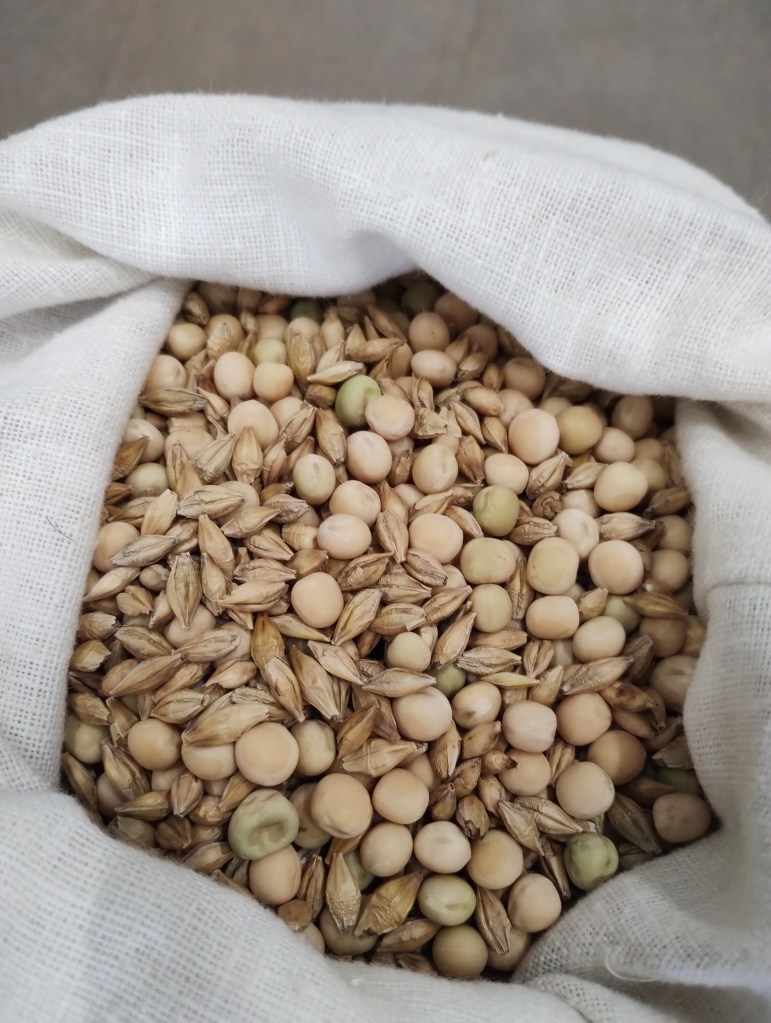
As a solution and opportunity for arable and mixed farmers, AgriLibra aims to provide the farmer a reliable marketplace for their mixed intercrop grains, aggregating the bulk for separation into its component grains.
We do the difficult part!
Translating impact for the grain trade:
Grain buyers and end users are becoming more forceful in their attempts to reduce their scope 3 emissions, tied to the carbon emissions occurring in the value chain for purchased goods. Several conglomerate grain buyers have stated at corporate level that they are now aiming to reduce CO2e emissions to under 50% of current levels, throughout the whole supply chain, placing pressure on farmers to transition to lower input (low output) systems to reduce field emissions or carbon offsetting options such as rewilding or tree planting, which creates conflicts in land use.
When scaled up across Scotland, AgriLibra has potential impact to reduce total agricultural emissions by 2% with 0.2% of cropped land (calculated using COOL Farm Tool with 5000t intake)
Transformative for homegrown protein supply:
UK animal feeds market accounts for around 12Mt annually, with cereals and pulses being the majority and imported soya making up 2.4Mt.
The livestock industry has faced major challenges in recent years following the reputational damage to meat-based diets linked to carbon emissions, as described in the UN report Livestock’s Long Shadow in 2006 stating the role of livestock production for 18% of global emissions, including related feed crop production
The importance of imported soya in livestock rations in the UK and EU is troublesome with links to deforestation and genetically modified varieties from South American sources. The EU has responded with policy restrictions on deforested sources, but to little effect.
Intercropping with peas or beans gives a viable opportunity for upscaling homegrown protein supply as a soya alternative.
The farmer led Nitrogen Climate Smart project has identified areas for use of home-grown peas and beans to replace 50% of imported soya meal used in livestock feed and increase pulse and a reduction of 1.5MtCO₂e p/a or 54% of the maximum potential for the industry by increasing legume cropping in arable rotations to 20% across the UK (currently 5%).
 AgriLibra at The James Hutton Institute